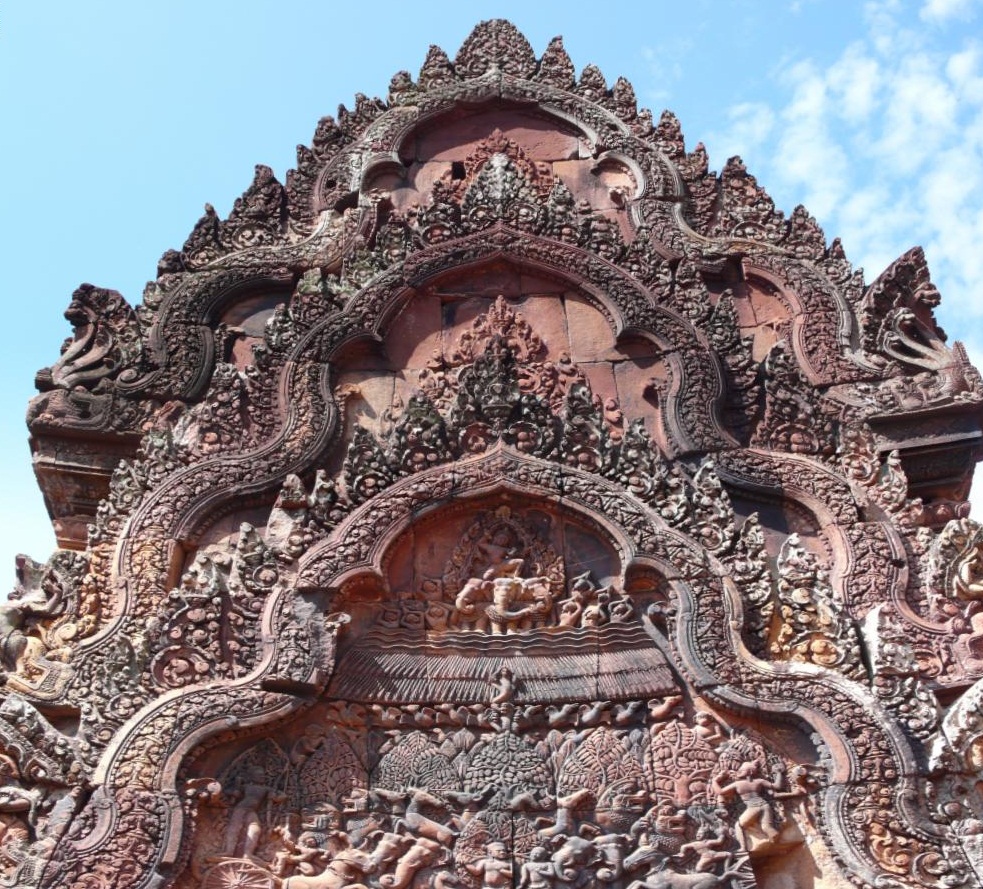
Now considerably behind our actual location (as of this post, we have left Cambodia and are headed to Laos!) this will be a highly-abbreviated overview of our final few weeks in Vietnam...
Cham ruins at Mỹ Sơn
Previously I mentioned our visit to the Cham Sculpture Museum in Danang. While in Hoi An, we had the opportunity to do a day trip to Mỹ Sơn, where you can see the remains of one of the ancient temple-cities of the Champan Empire, which flourished during the Second Century C.E., hearkening back over a thousand years to one of the regions most powerful ancient civilizations.
At the height of their expansion, they occupied much of what is now Southern Vietnam.
Remains of Cham cities can be found strewn across the landscape, and some of them are in excellent condition despite years of war/turmoil and the ravages of time. Unfortunately, Mỹ Sơn hasn't fared so well. It was badly damaged during the Vietnam-American War, when Viet Cong used the place as a base and attracted the attention of U.S. Bombers. Even so, the ruins that remain are quite enigmatic and mysterious, surrounded by jungle and set against a backdrop of beautiful mountains.
 |
| Better-preserved Cham temples awaited us in Nha Trang. Unfortunately, they were undergoing preservation work and covered in scaffolding. Along with geckos, KFC and World Heritage Sites, this would be a very pervasive phenomena throughout our trip (most annoyingly at Angkor Wat...but I digress...) | |
Cham culture was strongly influenced by India and the Hindu religion, and their building techniques and design motifs were similar to Khmer (Funan) styles seen at Angkor and elsewhere. Interestingly, they were also rivals of their Khmer neighbors and fought several wars with them. At one time, the Cham even managed to sack Angkor Wat before being driven out.Today, descendants of this ancient people continue to live in Vietnam as an ethnic minority group.
 |
| In this staged photo created purely for your amusement, Stacey pretends to sleep on the "Sleeper Bus" |
From Hoi An, we continued south to the city of Nha Trang via a “Sleeper Bus”. Basically this is a bus that's been outfitted with sleeping bays instead of seats where you can (in theory) lay down during the trip. In actuality, it wasn't an entirely successful venture. The bays were much too short for our body length, the road was quite bumpy and there was lots of horn honking (hey, it is Vietnam!) and there were frequent stops along the way. At each point, the helpful drivers insisted on waking up everyone so that we could get off the bus and use the disgusting roadside toilets and perhaps buy bananas. Everyone needs a bunch of 10-15 bananas at 3:00 in the morning, right? We eventually got to our destination, but it's not something I'd do again.
 |
| Nha Trang's beaches are party central and a popular destination. |
Nha Trang is a party beach town, and attracts a lot of young backpackers. It's also known for offshore diving. We only spent two days there, just long enough to recover from the sleeper bus and to enjoy a few sights around town. We hired a motorbike and braved the absolutely crazy traffic, which was essential to getting around but also a bit terrifying. Definitely was glad for the previous experience driving a motor scooter!
 |
| We enjoyed a mud bath and spa treatment at Thap Ba Hot Springs, near Nha Trang |
The beaches in Nha Trang didn't really do it for us, but they did whet our appetite for more. The next stretch of road between where we were and Saigon (Ho Chi Minh City) was quite long, so we decided to break it up with a stop in
Mui Ne. Long considered one of Vietnam's best beaches, it's easy to see why. There's gorgeous white sand stretching as far as the eye can see. The waves are relatively gentle - big enough to be fun and for light surfing, but not as bruising as at China Beach. The town itself is mostly tourism focused and quite developed, but still relatively sleepy and low-key.
 |
| Sunset at Mui Ne. |
We managed to enjoy a couple days of sitting on the beach and relaxing. Little did we know that trouble was about to strike...
 |
| Big trouble comes in a little striped package |
Some 5-8 days earlier, Stacey was bitten at some point by an
Aedes mosquito like the one shown above. They bite both day and night, and are common even in cities. They are also carriers of
Dengue Fever, and now Stacey had it. The symptoms resemble a severe flu at first (though without the coughing and stomach ailments) and include a massive headache and debilitating aches and pains, along with high fever, and sudden onset of fatigue. It comes on very quickly indeed, and within the span of a few hours she had gone from relaxing on the beach to collapsed in bed. We decided it was serious enough to get to Saigon where there were better medical facilities.
 |
| The Franco-Vietnamese Hospital was not originally on our list of 'things to see' in Saigon... |
A very long story made short, after many tests and doctor visits and several more days of declining health, she was eventually diagnosed with Dengue Fever. It takes about a week for the antibodies to appear as your body fights the virus. Dengue Fever is particularly insidious in that the symptoms change and occur in waves. The fever comes and goes, and sometimes you feel better only to be hit by something new (and worse!). The second wave includes a drop in your blood platelets, which is dangerous if you don't monitor it. Of the fatalities associated with Dengue Fever, internal bleeding as a result of low platelets is usually the cause. Stacey's dropped to below 50,000 platelets per ML, so she had to be admitted to the hospital for observation. She spent three unpleasant days there waiting for them to rise to a safe level again. Oh, but the fun didn't end with that - she also got to enjoy a body-wide itchy rash and swelling. It was no fun, but she did eventually get better and strong enough to go back to the hotel.
 |
| The skyline of sprawling Saigon (renamed Ho Chi Minh City after the reunification) |
For the next few weeks, she slowly got better but tired quickly. So, we took it easy for a while and did short excursions around Saigon. In the end, we spent about two weeks there, which was about 1.5 weeks longer than we planned! We did have to cut a bit from our planned itinerary as a result, but in the final analysis, we got lucky in that we had access to good medical facilities and Saigon was our next destination anyway.
A few sights from the city...
 |
| Modern Saigon is a bustling, busy and chaotic metropolis that buzzes at all hours. |
 |
| Like Kuala Lumpur in Malaysia, Saigon / HCMC is a place of contrasts. The gleaming new Bitexco skyscraper towers over the old city. Note the helicopter landing pad on its side. |
 |
| How would you like to be the repair person who has to sort out this tangled mess? This is the 'old Saigon' at it's best - chaotic, messy and seemingly out of control. |
 |
| William's favorite Vietnamese food: Phở (Vietnamese Noodle Soup). Normally served with pork, this is a veggie version. Note the hot chillies, fresh sprouts, lime and Asian herbs including Thai basil, Vietnamese mint, and more. YUM! |
 |
| The People's Committee Building, built in 1908 in French provincial style, could easily pass for a building in Paris. In the foreground is a photo with "Uncle Ho" sitting and telling stories to happy children. It's a frequent depiction of Vietnam's most enduring leader-hero. |
|
 |
| The interior of the post office is as impressive as the exterior. Any resemblance to the Eiffel Tower is surprise -- this building was designed by famous architect Gustave Eiffel. |
|
|
 |
| Saigon had many very nice public parks and gardens. In addition to trees, this park also featured many large propaganda-style posters showing happy Vietnamese people under Communist flags. |
|
Stacey descends into the Cu Chi Tunnels...
One interesting side trip from Saigon was to visit the
Cu Chi Tunnels. They were used by the Viet Cong (with devastating effectiveness) to hide and strike at American troops during the Vietnam-America War. There were about 75 miles of tunnels at one point, deep enough to withstand even the biggest bomb strikes and capable of holding entire villages of people. It was a major thorn in the side of the American military. Today, a few of the tunnels remain as a tourist attraction. Many have been enlarged to accommodate people more comfortably, but even so it's still quite claustrophobic. Like so many military history sites we saw/visited in Vietnam, this place stirred up some complex emotions that will be with me for some time.
 |
| Enjoying a boat journey in the Mekong Delta |
Our time in Vietnam was coming to a close, but we couldn't leave without at least seeing some of the
Mekong Delta. We decided to exit to Cambodia via a 3-day whirlwind tour of the Delta that took is to several destinations.
Arguably, this is the country's most defining region. Dubbed the 'River of Nine Dragons', referring to the nine distributaries as they pour out into the sea. It is the breadbasket of Vietnam, producing copious amounts of produce (especially rice) and fish. I can quote you statistics about just how huge the Mekong is, but none of them will do it justice. Let's just say that I grew up next to the Mississippi River, and always thought it was big. Well,
each one the nine branches of the Mekong is as big as the Mississippi. It's unbelievable.
 |
| Here, the woman on the small boat is buying pumpkins. Vendors hang fruits and veggies from long poles you can see from all around to let others know what they have for sale. |
The entire region is swamped with water, so much so that boats are more useful than cars, and often they double as housing. Since before recorded history, people have lived in the Delta according to the ebbs and flows and natural cycles of this mighty, life-giving river. Despite the incursion of modernity, many of these traditions still continue.
Dragon Fruit (a 'first' for us in Vietnam) in the orchard and piled high for sale, heading for the floating market!
And that brings us to a close for Vietnam. Unfortunately, it's not as introspective and eloquent as I might have liked but time is short and I have to sign off. Anyone who wants to see my 3,000+ photos of Vietnam and hear all about it in more detail, just let me know when I get back to the U.S. But, in the meantime, our little adventure continues. Next stop:
Phnom Penh, Cambodia followed by
Siem Reap and the
Temples of Angkor! You won't want to miss it. ;)